
Rummikub is easy to learn but surprisingly strategic once you understand how combinations work.
If you’ve just opened your box and aren’t sure what to do next, this guide will walk you through the game step by step — from setup to your first winning round.
If you’d like a broader overview first, you can also review the complete Rummikub Rules Guide before diving into the details.
Hi, I’m Daniel, and I’ll show you exactly how to play Rummikub in the clearest way possible.
Let’s begin.
Quick Overview: How Rummikub Works
• 2–4 players
• 14 tiles per player
• Create runs or groups
• First move must total 30 points
• First player to empty their rack wins
Now let’s break it down step by step.
Step 1: Understand the Goal of Rummikub
Your objective is simple:
Be the first player to play all your tiles onto the table by forming valid combinations.
There are only two types of legal combinations:
- Runs (same color, consecutive numbers)
- Groups (same number, different colors)
Once you play all your tiles, you win the round.
Step 2: Set Up the Game
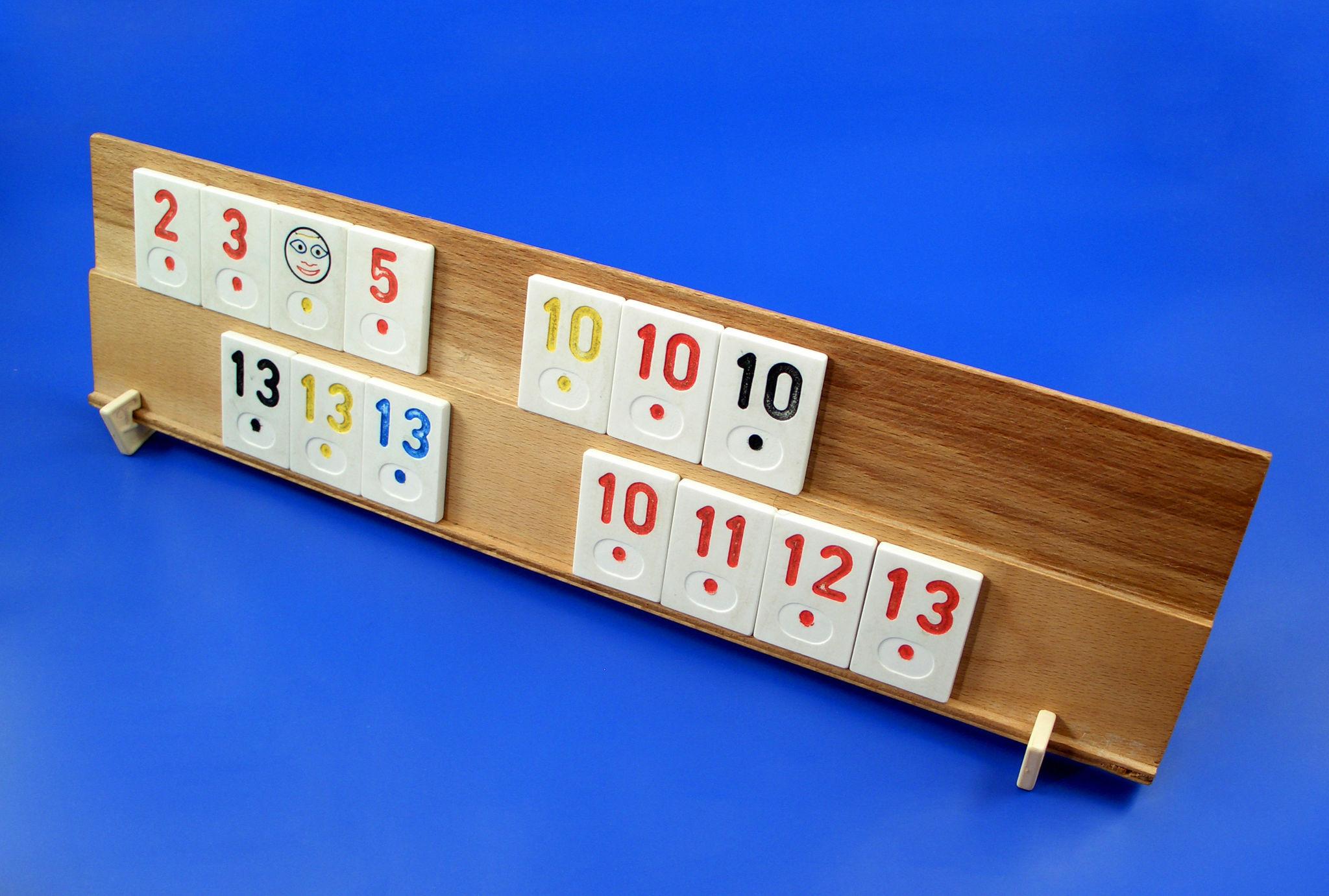
Setting up takes less than two minutes:
- Place all tiles face down on the table.
- Mix them thoroughly.
- Each player draws 14 tiles.
- Place tiles on your rack.
- Choose a starting player.
That’s it — you’re ready to start.
👉 For a complete breakdown with tips, see the full Rummikub Setup Instructions.
Step 3: Learn the Two Valid Rummikub Tile Combinations
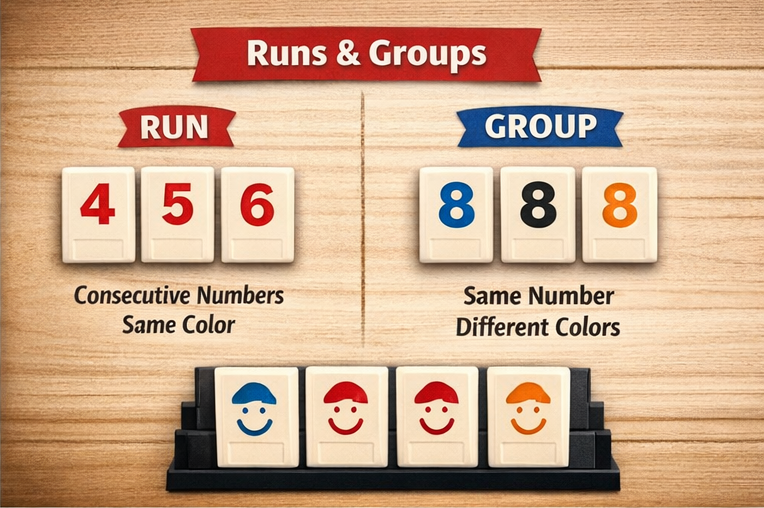
There are only two legal ways to place tiles on the table.
1️⃣ Runs
A run must be:
- 3 or more consecutive numbers
- All in the same color
Example:
Red 4 – Red 5 – Red 6
You cannot skip numbers.
2️⃣ Groups (Sets)
A group must be:
- 3 or 4 tiles
- Same number
- Different colors
Example:
Blue 8 – Black 8 – Orange 8
You cannot repeat a color in a group.
Master these two rules, and you understand the foundation of the game.
Step 4: The 30-Point Opening Rule
Before you can interact with tiles already on the table, you must complete your initial meld.
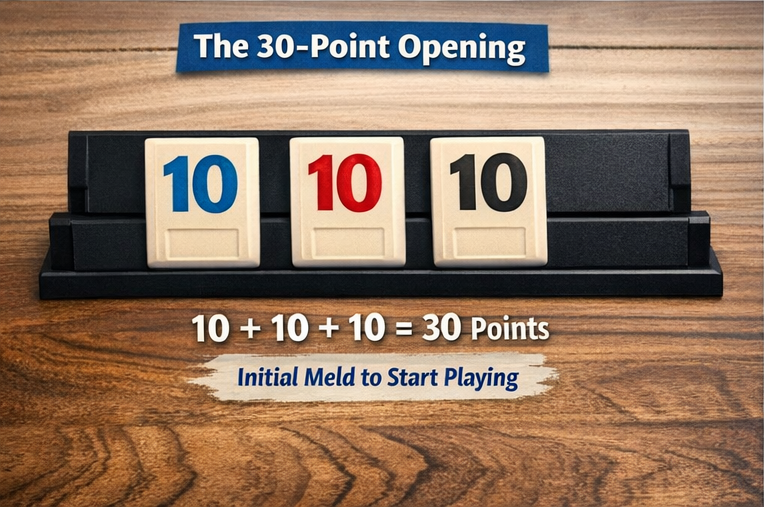
Your first move must total at least 30 points, using only tiles from your rack.
Points equal the number printed on the tile.
Example:
10 + 10 + 10 = 30 → valid opening move
If you cannot reach 30 points:
- Draw one tile
- End your turn
This rule keeps the early game structured and prevents chaotic play.
Step 5: Playing After You Open
Once you’ve opened, the game becomes much more flexible.
You may:
- Add tiles to existing sets
- Rearrange tiles on the table
- Split and rebuild combinations
Important rule:
Every combination must remain valid before your turn ends.
If you cannot make a valid move:
- Draw one tile
- End your turn
If you’re unsure what officially ends a round or what happens when no one can move, read the full explanation of the Rummikub Ending Rules.
This table manipulation is what makes Rummikub strategic rather than purely luck-based.
The Joker is the most flexible tile in the game.
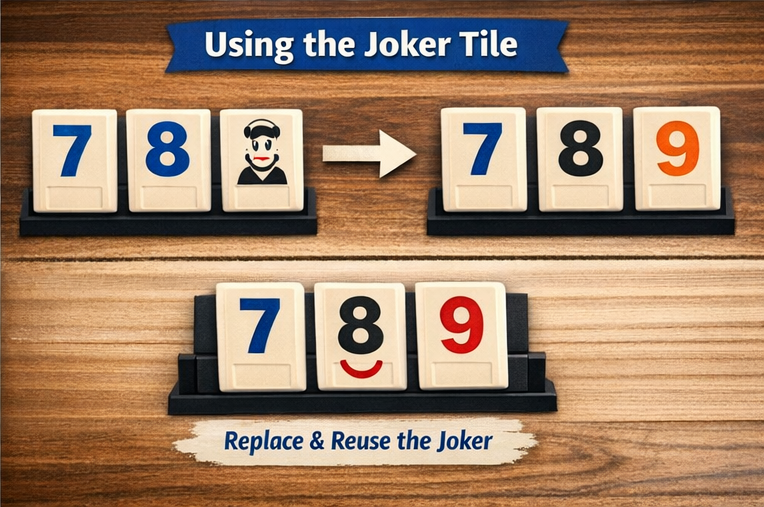
It can replace any tile in a valid run or group.
However:
- If another player holds the exact tile it represents, they may replace it.
- The Joker must immediately be reused in a new valid combination.
Used correctly, the Joker can completely shift momentum.
👉 For full examples and replacement rules, see the detailed Rummikub Joker Rules Guide.
Step 7: How to Win
The round ends when a player plays all their tiles.
Scoring works like this:
- All other players add up the numbers remaining on their racks.
- Those points are subtracted from their score.
- The winner receives the total of opponents’ leftover points.
You can play a single round or multiple rounds for a full game.
👉 Full breakdown in the Rummikub Scoring Guide.
Example of a Simple Turn
Imagine the table shows:
Blue 6 – Blue 7 – Blue 8
You hold:
Blue 9
You may extend the run:
Blue 6 – Blue 7 – Blue 8 – Blue 9
Now imagine you also hold:
Black 8
You could reorganize the table to create:
Blue 8 – Black 8 – Orange 8
As long as every combination remains valid, the move is legal.
This flexibility creates strategic depth.
Common Beginner Questions
Can I rearrange tiles on the table?
Yes — but all combinations must remain valid.
Can I open with multiple small combinations?
Yes, as long as they total at least 30 points.
What if I can’t play?
Draw one tile and end your turn.
Can I rearrange tiles during my first move?
No. Your first move must come entirely from your rack.
Beginner Tips to Improve Quickly
- Try to open as early as possible.
- Keep flexible number combinations.
- Avoid committing too heavily to one color.
- Don’t hold the Joker too long.
For more detailed advice, explore our full Beginner Tips Guide or dive deeper into the complete Rummikub Strategy Guide.
Once you understand these basics, the game becomes much more dynamic.
Final Thoughts
Learning how to play Rummikub is simple once you understand:
- The two valid combination types
- The 30-point opening rule
- How to safely manipulate the table
With just one or two rounds of practice, you’ll feel confident playing.
If you’re playing with different group sizes, you can also explore how the game changes in the Rummikub Variations Overview.
— Daniel Mercer